Aliakbar Mozayyan O Dolleh
Iran | 1844 - 1933About Aliakbar Mozayyan O Dolleh
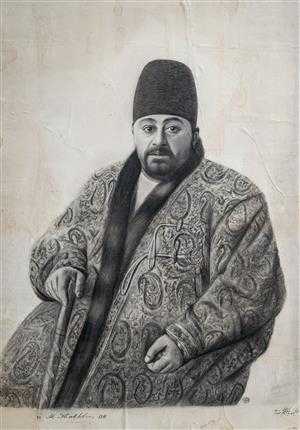
Aliakbar Khan Natanzi, nicknamed Mozayan o-Doleh and Naqshbashi (court painter), was one of the first painters sent to western countries during the Qajar period. He was one of the foremost painters who got acquainted with the principles of naturalism and book illustration in France, and after returning to Iran, he promoted this art style at Dar al-Funun school. He was the founder of Iranian theater in its western sense and worked in directing, design and translation.
Aliakbar Khan was born in a well-known and literate family in Natanz, Kashan. The family of "Mozayan o-Doleh" is one of the famous literary families of Iran, which has a long cultural and literary background over many years. As "Nezam Vafa" is the founder of the romantic school of contemporary Iranian literature, he is one of the celebrities of the same family and the nephew of "Mozayan o-Doleh." When "Farokh Khan Amin-ol-Molk Kashani nicknamed Amin o-Doleh" - Iran's ambassador during the Napoleon III era in Paris - left for France in 1853 for the Treaty of Paris, he took Mirza Aliakbar Khan with him to learn the French language. However, since he showed a lot of interest in painting art, he sent him to one of the art schools in France. Aliakbar Khan returned to Iran after a short period, but three years later, he was again selected as a member of the 24-member delegation of the student caravan and left Tehran at the beginning of Ramadan of the same year for France. He spent three years of primary education in the school of Dieppe and several years in the fine arts schools in Paris and the public school "Metz." There is a report in the 555th issue of the Iranian government newspaper: "Mr. Aliakbar is making progress in the painting industry day by day, and these days he is engaged in the science of perspective, which is the science of leveling and perspective drawing, to complete this art." After completing his studies in Paris, Mirza Aliakbar Khan completed his painting education with the famous 19th-century French painter "Dominique Anger" and finally returned to Iran in the first half of the decade of 1877. He entered the painter's house of the royal court, and shortly after, after the death of "Constante Francoise" (painting teacher of Dar al-Funun School), he was elected, and on November 3, 1870, according to the decree of Naser al-Din Shah, he was honored with the title of "court painter."
In the style and execution style of his paintings, he was mainly influenced by the methods of "naturalism" ruling the French painting scene, and in Iran, he was one of the first to follow the principles and rules of naturalism with entire purpose and seriousness. "Doost Ali Khan Moayer ol-Mamalek" has said about Aliakbar Khan's style of painting: "Although he was good at simulating, he did not pay much attention to it and preferred perspective and painting flower. ... he worked very quickly and with taste and used strong brush strokes. ... there were several elite tableaus of his in the Atabak Park mansion, which I often enjoyed watching."
Among the paintings of Mirza Aliakbar Khan, which are kept in the treasure of Golestan Palace and former royal domains and personal archives, we can mention the works "Beach Scene with a Wooden Hut," "Naser al-Din Shah Bust with Colored Pencil Technique," "Shua o-Sultane half-length with Siyah Ghalam and Pointillistic Technique" and paintings of landscape, flowers, and fruits. Also, he worked for some time in the illustration of lithographic books and popular novels of Alexander Dumas, among them the illustrations of the story "The Count of Monte Cristo" and "Jules Lermina," which were printed in Tehran in 1904. It is considered that it is copied from the images of the original version.
When the music school was established during the time of the Ministry of Education "Mokhber o-Doleh," Naqshbashi (court painter), who had extensive knowledge in art fields as well as music theory and military music in addition to the art of painting, was appointed to the position of the translator of Lumer, who was in charge of the Dar al-Funun music school. He translated the first music theory book into two Persian columns under "Definition of Music Science" and published it in 1883.
One of the most critical activities of Mozayan o-Doleh is creating the cornerstone of theater in Iran and spreading western-style plays in Iran. In 1885, by order of Naser al-Din Shah, who had closely observed and liked west's theaters, he established a theater influenced by European theaters with a small private hall adjacent to the royal palace. Mozayan o-Doleh himself is the first person to direct, organize and translate French plays in this theater, and with the help of several Austrian and French teachers of the Dar al-Funun school, he translated and adapted some of Moliere's plays and others in the same original language. He performed in the king's and the court's presence, and "because he was also a painter, he made the sets himself and prepared the European clothes he needed for the stage and did the make-up."
The Most Expensive Artwork
At Auctions
First Attendance
27 May 2016
# Attendance
2
# Artworks
2
Average Realized Price
18,759 USD
Average Min Estimate
12,224 USD
Average Max Estimate
17,199 USD
Sell-through Rate
100%
Average Growth of Artwork Worth
30.714%