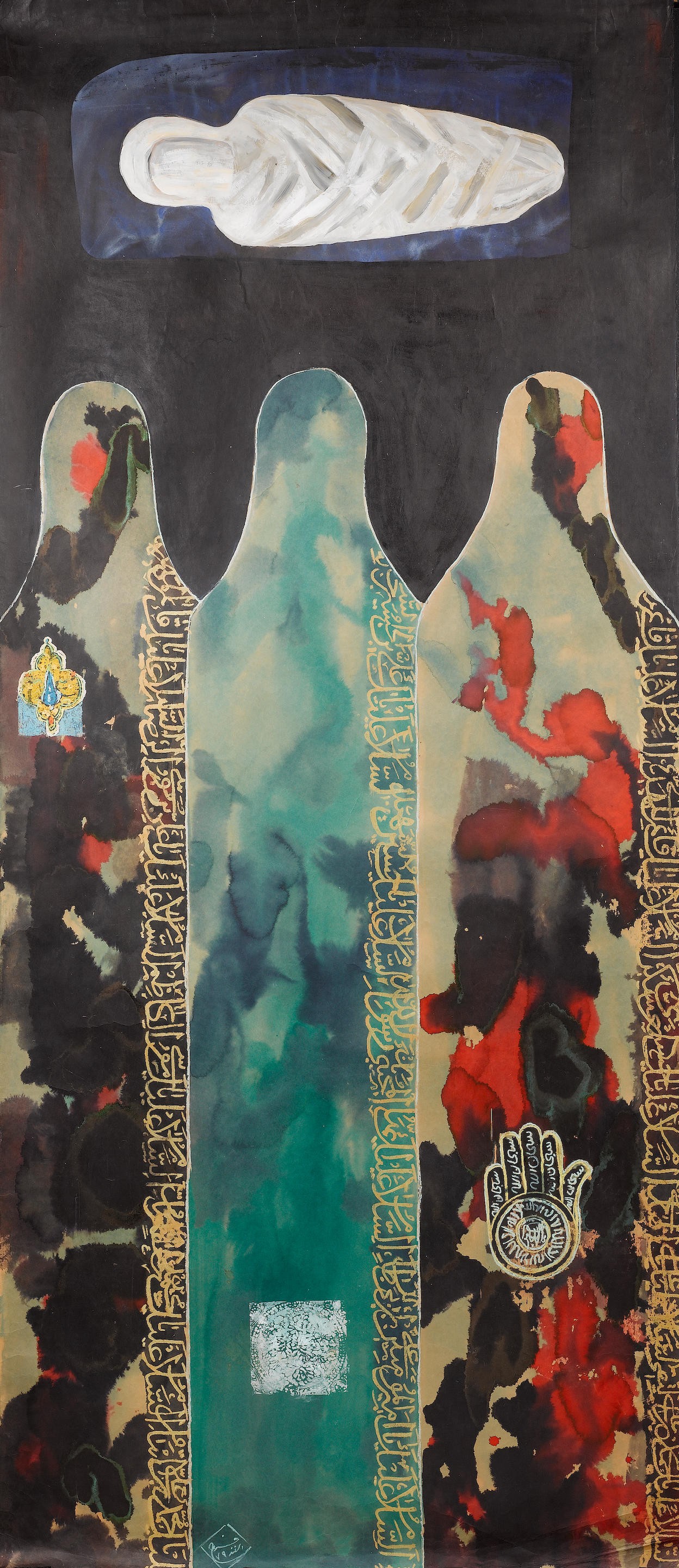
- Ashura 2000
- Acrylic on cardboard
- Painting
- 107 * 250 cm
- signed and dated in Farsi lower centre, framed
Artwork Description
Khosrow Hassanzadeh is one of the most important artists to emerge from Iran in the past decade. Both grand in scale, and bold in execution, Hassanzadeh's works combine a deep-seated interest in the aesthetic power of Iranian cultural imagery with the use of media and techniques inspired by the Western pop-art tradition. Whilst in the latter context, the techniques of pop-art were used to emphasise a shift towards the age of mass consumer production, Hassanzadeh uses the same framework to highlight the mass presence of cultural and religious imagery in the urban landscape of Iran.
As a veteran of the Iran-Iraq war and a painter of religious murals, Hassanzadeh has been firmly in touch with the colourful, artistic and extravert popular aspects of the religious culture of Iran; a sentiment which lies at the heart of his Ashura series. Continuing in the tradition of the sakkakhaneh artists, Hassanzadeh highlights a religious aesthetic which uses visual imagery as a means of public expression. In the Ashura series, he pays homage to the age-old ceremonial mourning of the death of the grandson of the Prophet Muhammad, Imam Hussein, who died together with his family in the battle of Karbala in 10AH (680 CE). A ceremony characterised by passionate, overt, public ritual mourning, the Ashura is a focal point of talismanic religious pageantry.
Whilst traditionally a patriarchal ritual, Hassanzadeh chooses the female form as the focal point of his composition, challenging the religious taboos which exist not only towards the role of women in society, but towards the supposed heresy of figural representation in Islamic art. The bold towering figures highlight the significance of the role of women in Ashura story, where Zeynab, the granddaughter of the Prophet and sister of Hussein, was captured and eventually died after the battle of Karbala. Despite their centrality, the women’s faces remain shrouded, a reference to the masked male actors who performed the roles of Zeynab and her companions in religious passion plays. Through this dual representation, Hassanzadeh reminds us that despite the importance of women in Islamic history and the veneration of the maternal ideal, they are oppressed by a male dominated society which punishes and marginalizes them for their femininity. The shrouded body of Aliasghar Ibn Hussein, the infant son of Imam Hussayn, killed with him at Karbala, is depicted above the female figures. A symbol of innocence and purity, it re-enforces Hassanzadeh’s gynocentric, maternal emphasis on the Ashura ritual, where the innocence of Aliasghar, and the sororal devotion of Zaynab are equally as important as the heroic of feats of Imam Hussein himself.
Whilst the majority of the artists works use the silkscreen method, the present piece is a unique painting, and is distinguished by its bold, scrolling calligraphy and talismanic symbols. In its veneration of femininity within a religious context, it is a piece which definitively encapsulates Hassanzadeh's artistic agenda; one which pays tribute to the visual beauty of Persian culture whilst emphasizing the role of those which it often overlooks and neglects.
As a veteran of the Iran-Iraq war and a painter of religious murals, Hassanzadeh has been firmly in touch with the colourful, artistic and extravert popular aspects of the religious culture of Iran; a sentiment which lies at the heart of his Ashura series. Continuing in the tradition of the sakkakhaneh artists, Hassanzadeh highlights a religious aesthetic which uses visual imagery as a means of public expression. In the Ashura series, he pays homage to the age-old ceremonial mourning of the death of the grandson of the Prophet Muhammad, Imam Hussein, who died together with his family in the battle of Karbala in 10AH (680 CE). A ceremony characterised by passionate, overt, public ritual mourning, the Ashura is a focal point of talismanic religious pageantry.
Whilst traditionally a patriarchal ritual, Hassanzadeh chooses the female form as the focal point of his composition, challenging the religious taboos which exist not only towards the role of women in society, but towards the supposed heresy of figural representation in Islamic art. The bold towering figures highlight the significance of the role of women in Ashura story, where Zeynab, the granddaughter of the Prophet and sister of Hussein, was captured and eventually died after the battle of Karbala. Despite their centrality, the women’s faces remain shrouded, a reference to the masked male actors who performed the roles of Zeynab and her companions in religious passion plays. Through this dual representation, Hassanzadeh reminds us that despite the importance of women in Islamic history and the veneration of the maternal ideal, they are oppressed by a male dominated society which punishes and marginalizes them for their femininity. The shrouded body of Aliasghar Ibn Hussein, the infant son of Imam Hussayn, killed with him at Karbala, is depicted above the female figures. A symbol of innocence and purity, it re-enforces Hassanzadeh’s gynocentric, maternal emphasis on the Ashura ritual, where the innocence of Aliasghar, and the sororal devotion of Zaynab are equally as important as the heroic of feats of Imam Hussein himself.
Whilst the majority of the artists works use the silkscreen method, the present piece is a unique painting, and is distinguished by its bold, scrolling calligraphy and talismanic symbols. In its veneration of femininity within a religious context, it is a piece which definitively encapsulates Hassanzadeh's artistic agenda; one which pays tribute to the visual beauty of Persian culture whilst emphasizing the role of those which it often overlooks and neglects.
More lots by Khosrow Hassanzadeh
Realized Price
12,769 USD
Min Estimate
9,843 USD
Max Estimate
14,138 USD
Average Artwork Worth
+0.455%
Average Growth of Artwork Worth
Sales Performance Against Estimates
Average & Median Sold Lot Value
2021 - 2025
Performance vs. Estimate
2021 - 2025
Sell-through Rate
2021 - 2025
Similar Artworks
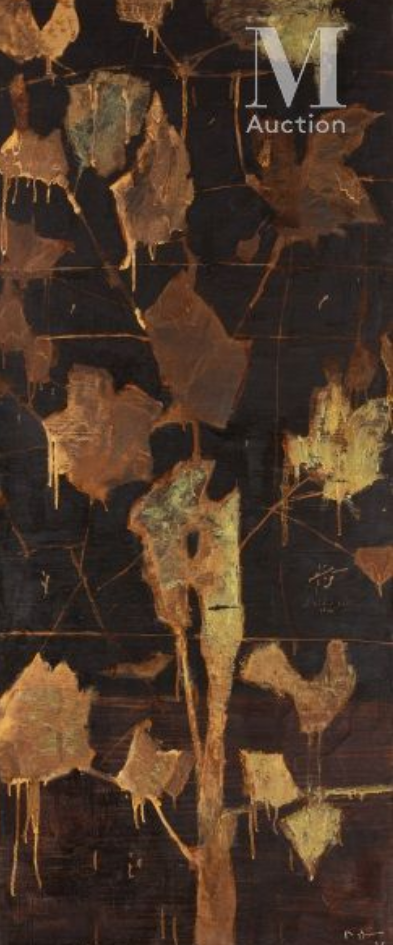
From the series "The Rose & Nightingale"
Estimation
€20,000
24,375 USD
-
€25,000
30,469 USD
Realized Price
€20,000
24,375 USD
11.111%
Sale Date
Millon & Associés
-
16 June 2021