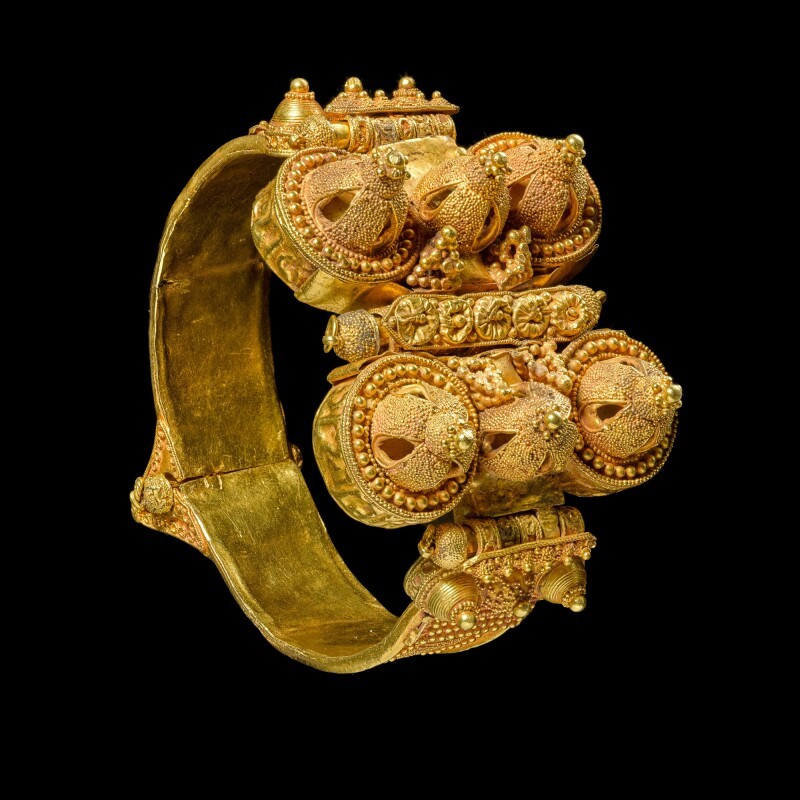
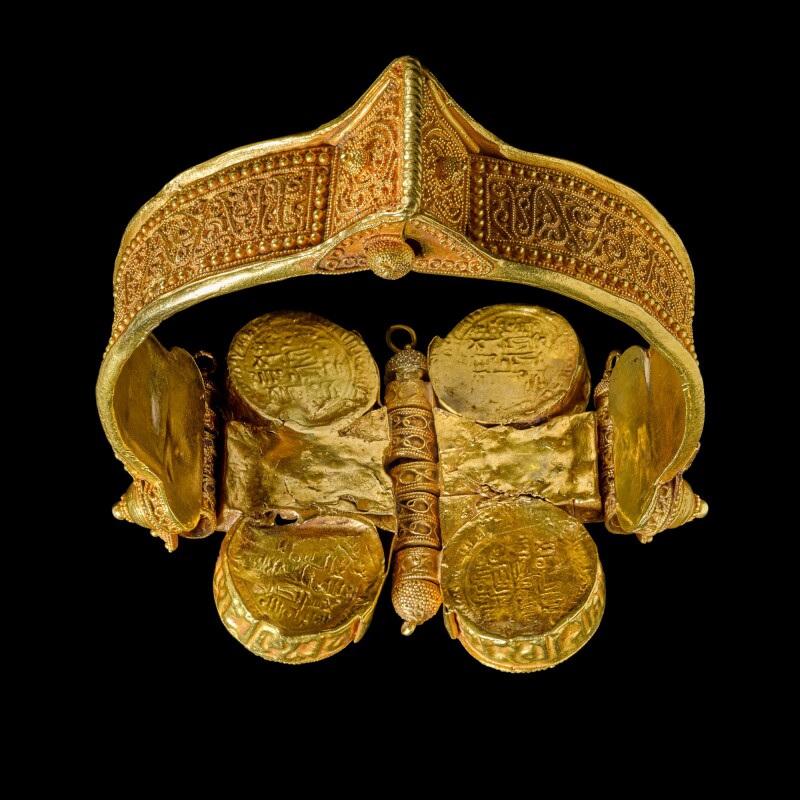
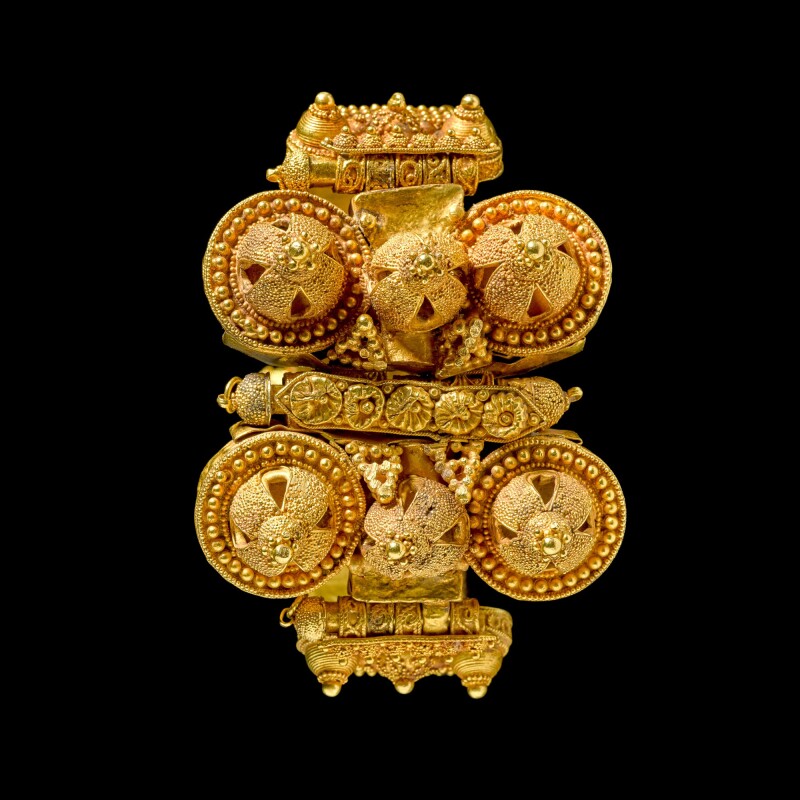
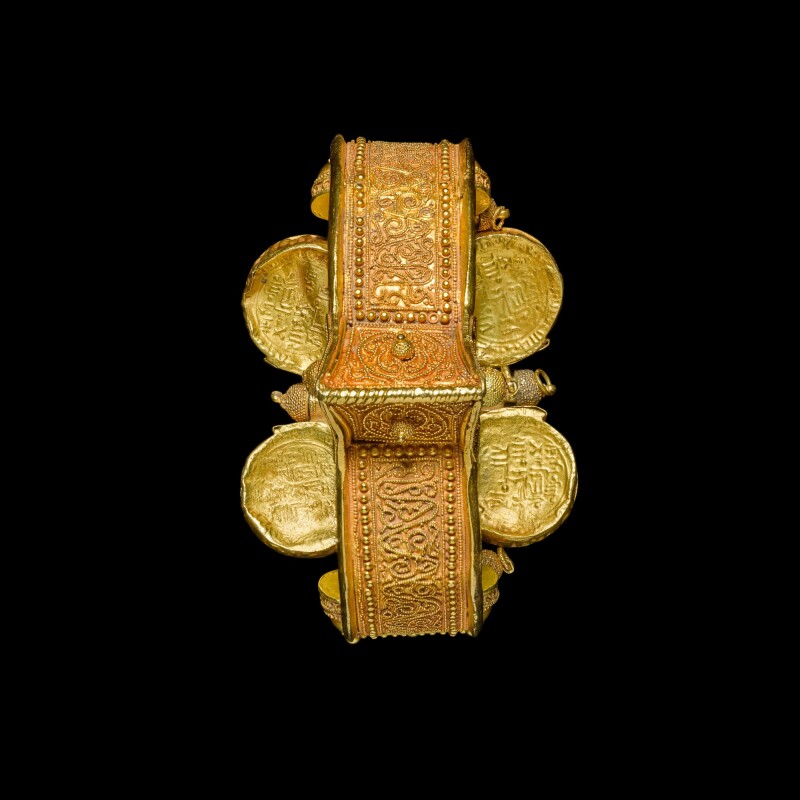
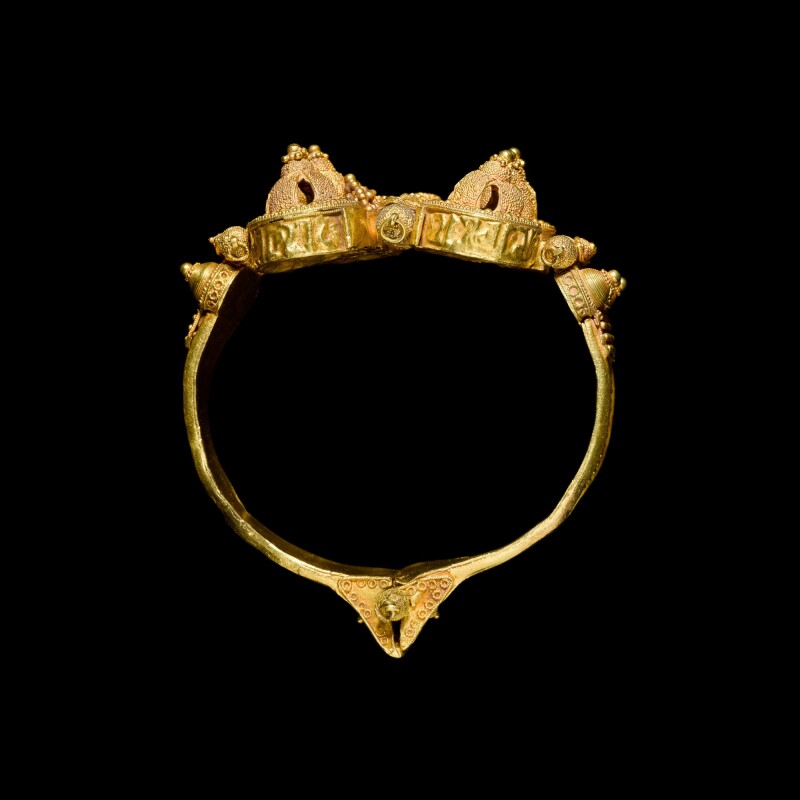
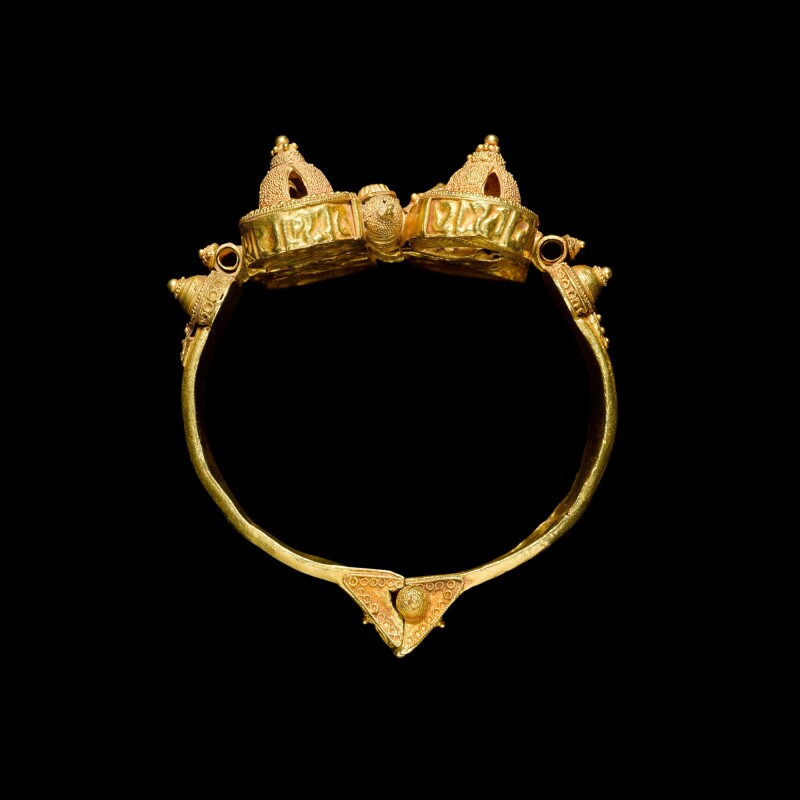
- A Seljuq gold armlet, Persia, 11th century
- Handicrafts and classics, Jewelry and accessories
- the hoop with a band decorated with granulation forming a weave-like pattern, the front with six hemispheres also decorated with granulation; the upper and lower hemispheres encircled by a row of beads; the reverse with four flat disks of thin gold cast from a coin mentioning the name of the Abbasid caliph al-Qa’im; the central hinge with a row on five rosettes, the sides hinges with rows of knot-like decoration and small hemispheres8cm. diam.
Estimation
£80,000
104,712 USD
-
£100,000
130,890 USD
Realized Price
£100,800
131,937 USD
12%
Artwork Description
This exceptional bracelet is a rare example of Seljuq jewellery. The cast discs on the reverse are Persian, made during the reign Alp Arslan, Great Seljuq (r.1063-72), allowing us to date the piece with some accuracy. It can be compared to an armlet in the Metropolitan Museum of Art in New York, and another in the Freer Gallery of Art in Washington D.C., both dated to the eleventh century.
inscriptions
'There is no god but God, the Unique. He has no associate. Al-Qa’im bi-Amr Allah'
Around the domes:
‘Sovereignty is Gods, the One’
Few pieces of jewellery of such quality survive from Medieval Central Asia. The two closest comparables are now in the Metropolitan Museum of Art in New York, inv. no. 57.88a-c and in the Freer Gallery in Washington, inv. no.F1958.6.
All three pieces are decorated by a group of symmetrical hemispheres, four in the pieces in the U.S.A., six in the current lot, all encircled by smaller beads. These hemispheres are decorated with granulation, a technique which consists in joining small balls to a base and which was largely used since the Etruscans, as displayed on an ear-stud dated to the sixth century BC now in the British Museum, London, inv. no.1842,0728.137. This technique was employed all over Asia, with pieces dated back to the Shunga period in India or Tang Dynasty in China. For further information about granulation see Untracht 1982, pp.348-63.
Both the pieces in the American institutions have a body consisting of a rounded and twisted armband, which derives from Greek models and was common in the Mediterranean (see, for example, a bracelet with a twisted hoop attributed to eleventh century Syria, now in the Freer Gallery of Art, inv. no.48.25). The piece to hand, however, has a wide flat hoop decorated with granulation forming waves and circles.
The four flat coin-like discs on the reverse are not coins themselves but are casts or pounces, all probably made from the same coin, except for one which may be a replacement. There are four lines of text: the first three are the shahada while the fourth mentions the name of the Abbasid caliph al-Qa’im (r.1031-75). The circular rims include a date (457 AH/1064 AD) and possibly the name of a place where the coin from which these casts were made was produced, which might read ‘Nishapur’. The casts themselves are dated to the eleventh century, during the reign Alp Arslan, Great Seljuq (r.1063-72 AD) and were probably made not too long after the coins were minted, quite likely while al-Qa’im was still Caliph.
The form of the hoop is flatter and as such differs from the Freer and Metropolitan Museum examples. This raises the question of whether the bezel decorated with domes is attached to a hoop to which it did not originally belong, or whether a hybrid style is in evidence, mixing Fatimid, Iraqi and Persian elements. It may also point to significant restoration at a later date.
More lots by Unknown Artist
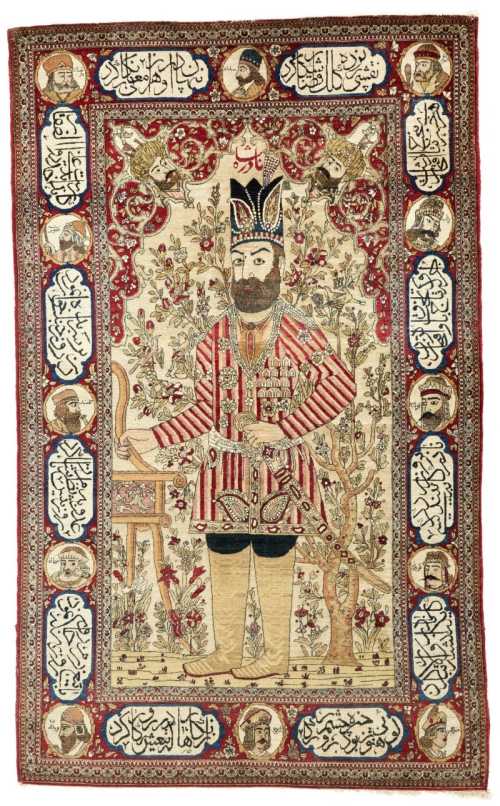
An Isfahan pictorial rug, Central Persia, circa 1910
Estimation
£4,000
5,236 USD
-
£6,000
7,853 USD
Realized Price
£5,670
7,421 USD
13.4%
Sale Date
Sotheby's
-
30 March 2022
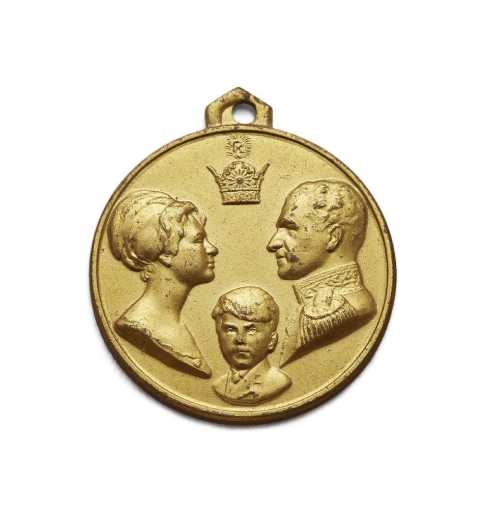
A gold medal commemorating the coronation of Muhammad Reza Shah and Queen Farah
Estimation
£100
132 USD
-
£200
263 USD
Realized Price
£160
211 USD
6.667%
Sell at
Sale Date
Rosebery's Auction
-
1 April 2022
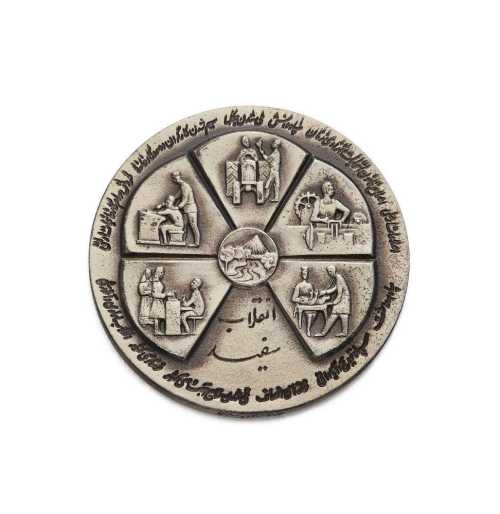
A silver memorial medal of the White Revolution, Muhammad Reza Shah, 1967
Estimation
£200
263 USD
-
£300
395 USD
Realized Price
£170
224 USD
32%
Sell at
Sale Date
Rosebery's Auction
-
1 April 2022
Realized Price
67,245 USD
Min Estimate
35,481 USD
Max Estimate
53,247 USD
Average Artwork Worth
+83.63%
Average Growth of Artwork Worth
Sales Performance Against Estimates
Average & Median Sold Lot Value
2021 - 2025
Performance vs. Estimate
2021 - 2025
Sell-through Rate
2021 - 2025