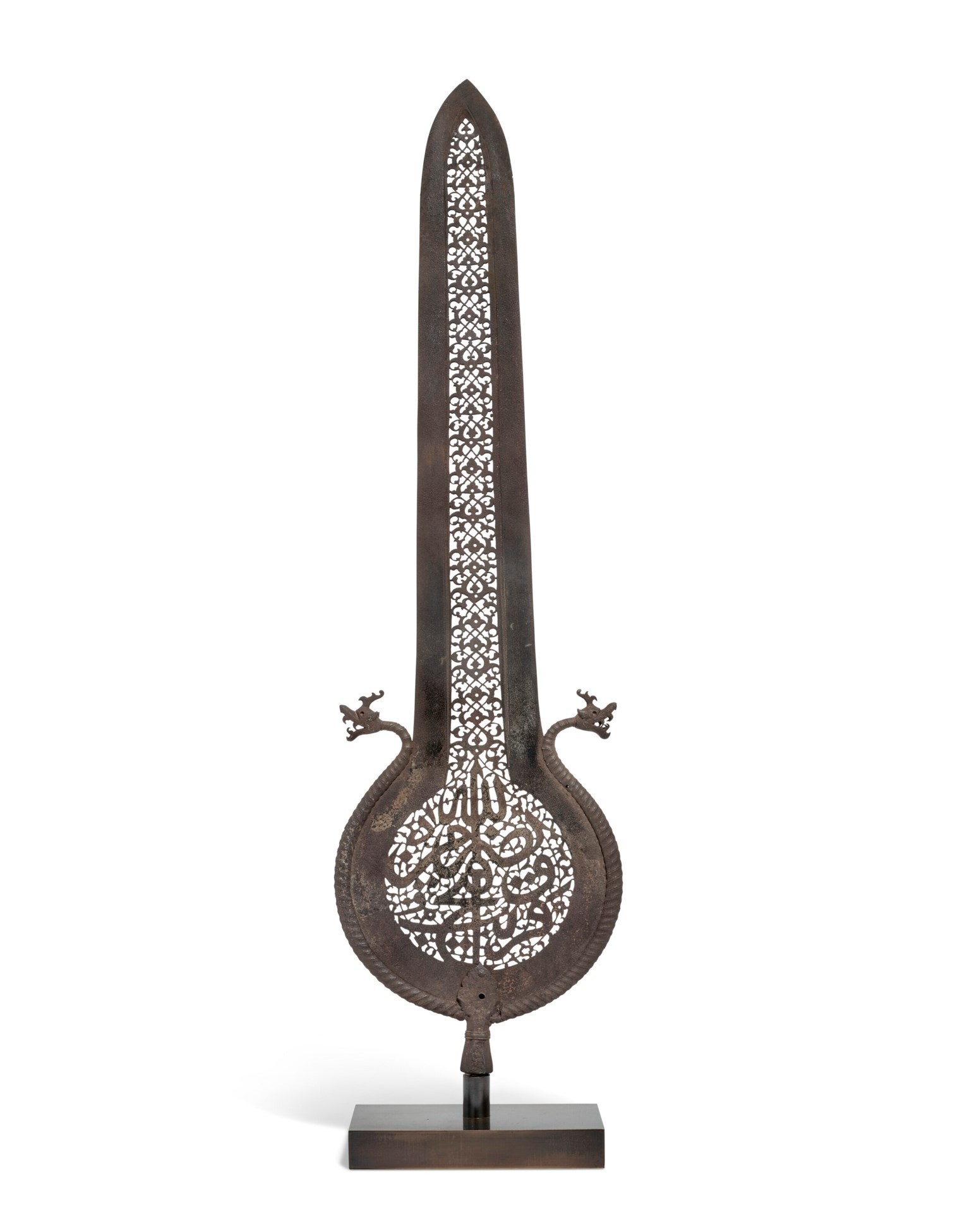
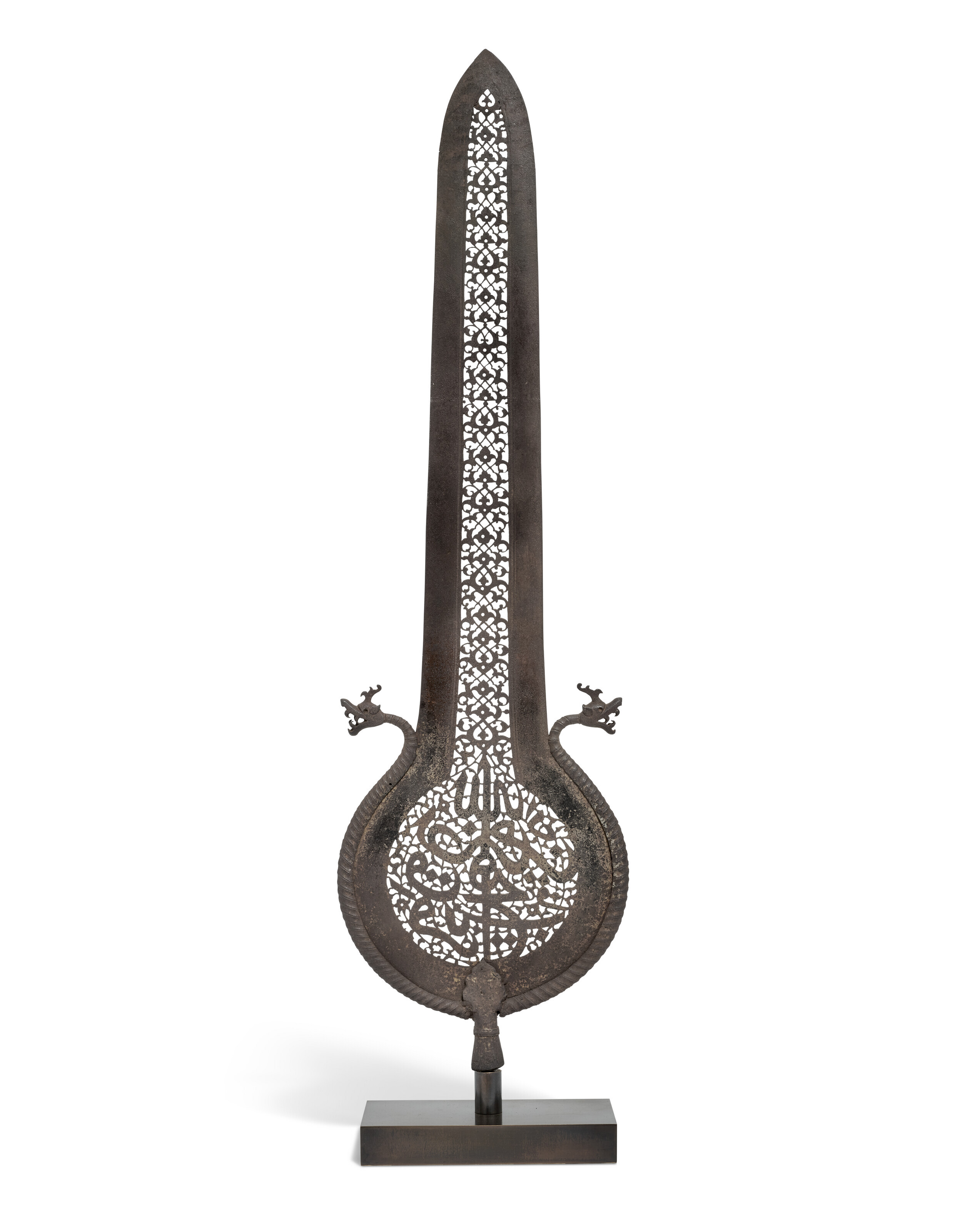
- A PIERCED-STEEL PROCESSIONAL STANDARD ('ALAM)
- Handicrafts and classics, Metal
- 92.8 cm
- SAFAVID IRAN, 17TH OR 18TH CENTURY
Of drop shape with extending upper panel, with openwork scrolling decoration issuing palmettes and flowerheads, the work in the main body with a benedictory inscription in naskh, a ribbed exterior band issuing dragons' heads, cusped base plate, contemporary metal block base
36 1⁄2in. (92.8cm.) high
Estimation
£12,000
15,794 USD
-
£18,000
23,690 USD
Realized Price
£12,600
16,583 USD
16%
Artwork Description
nasr min Allah wa fath qari, 'Victory from God and victory is near'
Military, royal and religious metal standards (‘alam) can be traced back to early times in Iran. They occur for example, among Luristan bronzes and Achaemenid depictions. By the second half of the 14th century a central ornament above a pair of inward facing dragon’s heads was evidently an important, possibly royal, type of military emblem, as seen on some contemporaneous miniatures of the time. In the mid-15th century, however, the design destined to dominate standard styles for the following centuries was introduced – a pear shaped centre, an ornamental point, and a double dragon, with their heads turned outwards rather than inwards, as seen on our example (James Allan and Brian Gilmour, Persian Steel. The Tanavoli Collection, Oxford Studies in Islamic Art XV, Oxford, 200, pp. 254-55). The pictorial evidence available from the 14th to 17th century demonstrate the use of standards in battle and as a indicators of the presence of the sovereign. By the early 17th century, however, standards had assumed a religious role as well. Olearius, amongst other European travellers to Persian in the 17th century, describes a number of examples where ‘alams were used in non-imperial context, supporting their religious importance in the 17th century (Allan and Gilmour, op.cit., p. 259). Our almond shaped ‘alam would have been used in such religious ceremonies in the later Safavid period, and falls into group B of Allan’s different groups of ‘alams (Allan and Gilmour, op.cit., p.268).
Melikian-Chirvani discusses the royal symbolism of dragon heads (A.S. Melikian-Chirvani, ‘Le Shah-Name, la gnose soufie et le pouvoir mongol’, Journal Asiatique, vol.272, nos.1-2, 1984, p.323) whilst contemporary craftsman believe that the dragon’s heads protect the Qur’anic verses through their fiery breath, as seen in our example (Allan and Gilmour, op.cit., p.263). Standard making in contemporary Iran is still an active guild since they are used to commemorate the shi’a religious mourning rituals around the battle of Karbala.
An impressive pierced steel Safavid ‘alam with similar dragon heads sold in these Rooms, 27 April 2017, lot 93. Another earlier dated example sold at Sotheby’s London, 24 October 2018, lot 139.
Military, royal and religious metal standards (‘alam) can be traced back to early times in Iran. They occur for example, among Luristan bronzes and Achaemenid depictions. By the second half of the 14th century a central ornament above a pair of inward facing dragon’s heads was evidently an important, possibly royal, type of military emblem, as seen on some contemporaneous miniatures of the time. In the mid-15th century, however, the design destined to dominate standard styles for the following centuries was introduced – a pear shaped centre, an ornamental point, and a double dragon, with their heads turned outwards rather than inwards, as seen on our example (James Allan and Brian Gilmour, Persian Steel. The Tanavoli Collection, Oxford Studies in Islamic Art XV, Oxford, 200, pp. 254-55). The pictorial evidence available from the 14th to 17th century demonstrate the use of standards in battle and as a indicators of the presence of the sovereign. By the early 17th century, however, standards had assumed a religious role as well. Olearius, amongst other European travellers to Persian in the 17th century, describes a number of examples where ‘alams were used in non-imperial context, supporting their religious importance in the 17th century (Allan and Gilmour, op.cit., p. 259). Our almond shaped ‘alam would have been used in such religious ceremonies in the later Safavid period, and falls into group B of Allan’s different groups of ‘alams (Allan and Gilmour, op.cit., p.268).
Melikian-Chirvani discusses the royal symbolism of dragon heads (A.S. Melikian-Chirvani, ‘Le Shah-Name, la gnose soufie et le pouvoir mongol’, Journal Asiatique, vol.272, nos.1-2, 1984, p.323) whilst contemporary craftsman believe that the dragon’s heads protect the Qur’anic verses through their fiery breath, as seen in our example (Allan and Gilmour, op.cit., p.263). Standard making in contemporary Iran is still an active guild since they are used to commemorate the shi’a religious mourning rituals around the battle of Karbala.
An impressive pierced steel Safavid ‘alam with similar dragon heads sold in these Rooms, 27 April 2017, lot 93. Another earlier dated example sold at Sotheby’s London, 24 October 2018, lot 139.
More lots by Unknown Artist
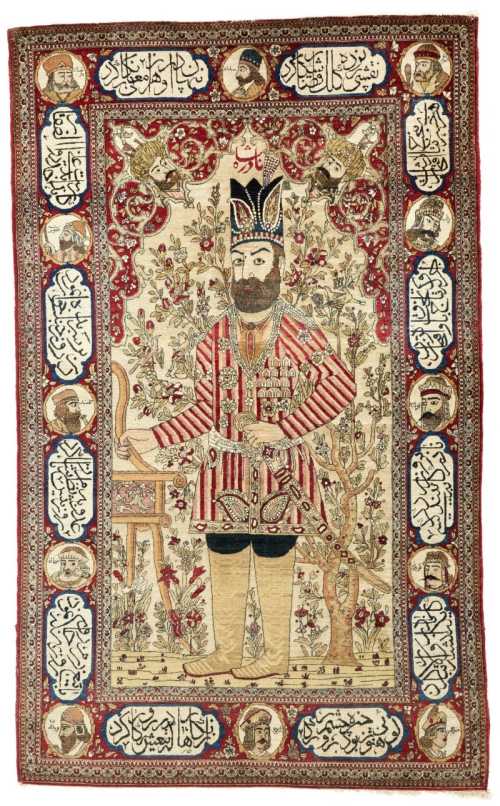
An Isfahan pictorial rug, Central Persia, circa 1910
Estimation
£4,000
5,236 USD
-
£6,000
7,853 USD
Realized Price
£5,670
7,421 USD
13.4%
Sale Date
Sotheby's
-
30 March 2022
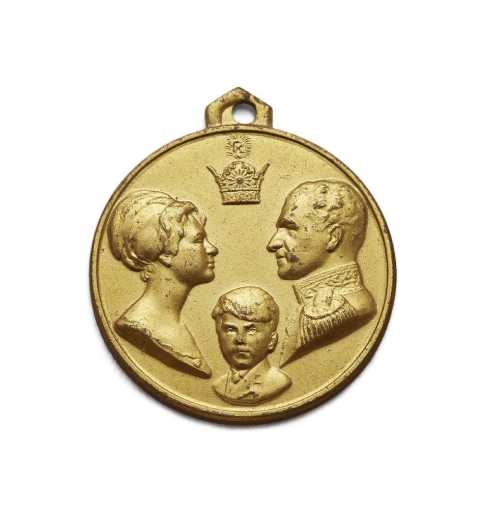
A gold medal commemorating the coronation of Muhammad Reza Shah and Queen Farah
Estimation
£100
132 USD
-
£200
263 USD
Realized Price
£160
211 USD
6.667%
Sell at
Sale Date
Rosebery's Auction
-
1 April 2022
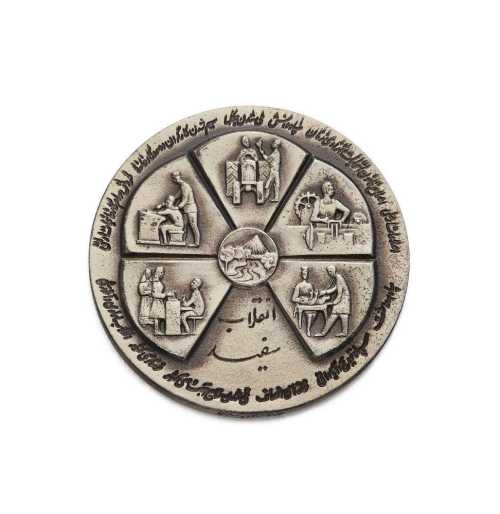
A silver memorial medal of the White Revolution, Muhammad Reza Shah, 1967
Estimation
£200
263 USD
-
£300
395 USD
Realized Price
£170
224 USD
32%
Sell at
Sale Date
Rosebery's Auction
-
1 April 2022
Realized Price
67,245 USD
Min Estimate
35,481 USD
Max Estimate
53,247 USD
Average Artwork Worth
+83.63%
Average Growth of Artwork Worth
Sales Performance Against Estimates
Average & Median Sold Lot Value
2021 - 2025
Performance vs. Estimate
2021 - 2025
Sell-through Rate
2021 - 2025