
- Dream
- Oil on canvas
- Painting
- 91 * 151 cm
- signed lower right, framed
Artwork Description
On first sight, Nasser Ovissi's paintings seem to fit comfortably into the neo-traditionalist school Iranian modern art, and whilst they do draw key visual elements from ancient Persian miniature painting, they are fragmented, jarred and re-interpreted in a strictly contemporary framework.
Ovissi's work has strong connections with Iranian artistic and architectural imagery. The two, solemn, entombed figures lying at the bottom of the painting resemble Persian miniature characters, but their bodies are broken up by fragments of tile work containing Islamic calligraphy. The central composition is flanked by further various architectural fragments; in the top left corner the mosaic-decorated dome of an Iranian mosque is shown, and on the far right more details of a mosque's interior are depicted. Other, more subtle elements include a faint imperial blazon above the arm of one of the reclining figures and pointed arches, which cast shadows over the top half of the canvas.
This architectural patchwork represents the diverse composition of Persian culture, a rich, vastly complex amalgamation of pre-Islamic, Islamic Royal, and spiritual influences, all of which characterise the overall aesthetic of Iranian art. Ovissi's depiction reflects this multilayered artistic tradition by disfiguring various elements and detaching them from their natural settings. The resulting effect is an artwork, which both celebrates and laments Iran's artistic heritage. The colour, decoration, and striking imagery are a homage to the glorious past, but the pale, lifeless, entombed figures a reminder that these images belong to a bygone age, whose memory has been fragmented by time and rendered only partially accessible. Ultimately, Ovissi's image glorifies the rich and beautiful heritage of his land whilst correctly recognising that it is firmly rooted in the past, a period of time, which can only be glimpsed in a disparate and disjointed manner.
Ovissi's work has strong connections with Iranian artistic and architectural imagery. The two, solemn, entombed figures lying at the bottom of the painting resemble Persian miniature characters, but their bodies are broken up by fragments of tile work containing Islamic calligraphy. The central composition is flanked by further various architectural fragments; in the top left corner the mosaic-decorated dome of an Iranian mosque is shown, and on the far right more details of a mosque's interior are depicted. Other, more subtle elements include a faint imperial blazon above the arm of one of the reclining figures and pointed arches, which cast shadows over the top half of the canvas.
This architectural patchwork represents the diverse composition of Persian culture, a rich, vastly complex amalgamation of pre-Islamic, Islamic Royal, and spiritual influences, all of which characterise the overall aesthetic of Iranian art. Ovissi's depiction reflects this multilayered artistic tradition by disfiguring various elements and detaching them from their natural settings. The resulting effect is an artwork, which both celebrates and laments Iran's artistic heritage. The colour, decoration, and striking imagery are a homage to the glorious past, but the pale, lifeless, entombed figures a reminder that these images belong to a bygone age, whose memory has been fragmented by time and rendered only partially accessible. Ultimately, Ovissi's image glorifies the rich and beautiful heritage of his land whilst correctly recognising that it is firmly rooted in the past, a period of time, which can only be glimpsed in a disparate and disjointed manner.
More lots by Nasser Ovissi
Realized Price
12,125 USD
Min Estimate
8,249 USD
Max Estimate
11,672 USD
Average Artwork Worth
+29.238%
Average Growth of Artwork Worth
Sales Performance Against Estimates
Average & Median Sold Lot Value
2021 - 2025
Performance vs. Estimate
2021 - 2025
Sell-through Rate
2021 - 2025
Similar Artworks
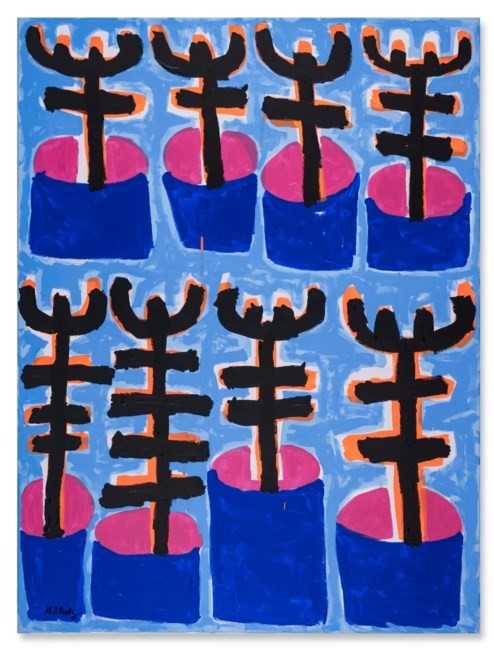
My Garden’s Details No. 3
Dhikr (From the Platonic Solids Series)
Estimation
£15,000
18,627 USD
-
£20,000
24,835 USD
Realized Price
£20,320
25,233 USD
16.114%
Sale Date
Sotheby's
-
25 April 2023